


The Coredio Blog
Read our latest blogs to understand more insights about our platform
FOR CARE COORDINATORS · WORKFLOW · 5 MIN READ
Why rising LVEDP, not body weight, should be the trigger for treatment escalation in heart failure.
The lag problem in heart failure care
Modern heart failure management remains largely reactive. The traditional toolkit — periodic echocardiograms, scheduled clinic visits, daily weights, and patient-reported symptoms — gives clinicians a sparse, lagging picture of a evolving physiology. By the time a patient reports dyspnea or gains three pounds, intracardiac pressures have typically been rising for several days. The decompensation cascade does not begin at the scale; it begins at the ventricle.
This delay has measurable consequences. Roughly one in four patients hospitalized for heart failure is readmitted within 30 days, and the majority of those admissions stem from progressive congestion that began before the index discharge was reversed. The clinical question is no longer whether earlier signals exist, but whether we can capture them at sufficient resolution to act on them.
LVEDP rises first
Left ventricular end-diastolic pressure is the most consistent early marker of impending decompensation in patients with reduced or preserved ejection fraction. Elevations in LVEDP precede overt pulmonary congestion by several days, often before weight gain or peripheral edema become apparent on examination. The physiology is straightforward: as ventricular compliance falls or filling pressures climb, the left atrium and pulmonary circulation absorb the load first. Symptoms arrive only after that buffer is exhausted.
Direct LVEDP measurement, however, has traditionally required left heart catheterization or implantable hemodynamic sensors. Both carry meaningful constraints. Catheterization is invasive, episodic, and ill-suited to longitudinal monitoring. Implanted sensors deliver data but require a procedure, ongoing technical support, and patient selection that excludes much of the at-risk population. For most ambulatory heart failure patients, the gold-standard pressure signal has simply been unavailable.
What non-invasive monitoring changes
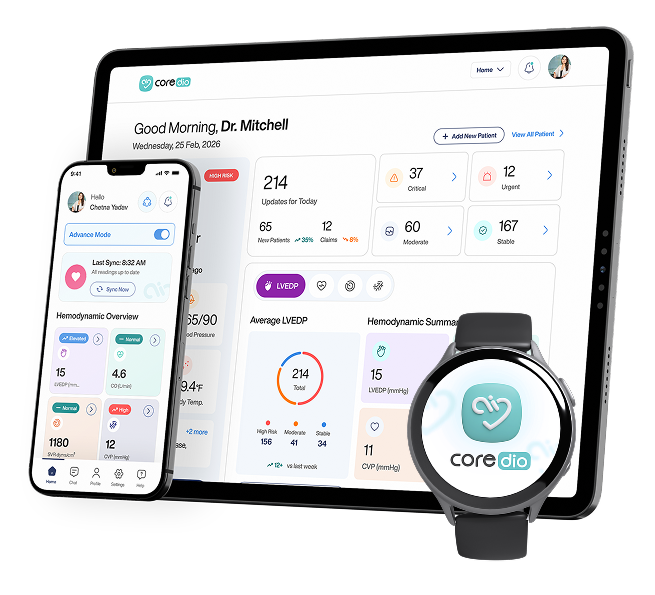
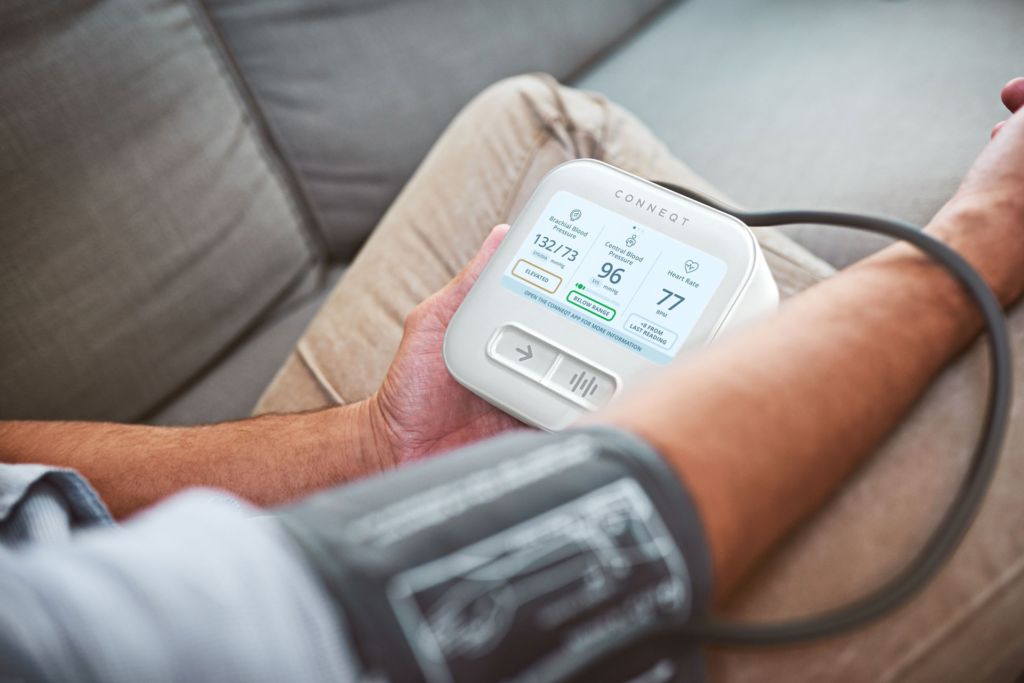
Coredio’s approach is to estimate intracardiac hemodynamics from signals patients already generate — photoplethysmography and electrocardiogram waveforms from a consumer-grade smartwatch, paired with intermittent blood pressure cuff readings. A one-time, twenty-minute calibration session in clinic, incorporating radial, carotid, and brachial ultrasound, establishes a patient-specific digital twin. That model is designed to maintain accuracy for up to three years and produces four updated parameters: LVEDP, Cardiac Index, Systemic Vascular Resistance, and Central Venous Pressure.
Validation work to date at Strong Memorial Hospital reports deviations of under 5 mmHg for blood pressure and under 5 percent for cardiac output relative to invasive reference measurements. These figures sit within the range of clinical equivalence for catheterization-derived values, and they are produced without procedural risk, contrast, or radiation.
The interpretive shift is the meaningful one. Instead of asking what a patient’s filling pressure was six weeks ago, the clinician can see what it is today, and whether the trajectory over the past 48 hours warrants pharmacologic adjustment.
Implications for daily practice
Hemodynamic data does not replace clinical judgment, but it does sharpen the questions a cardiologist can ask. A patient whose LVEDP has drifted from 14 to 19 mmHg over five days, with stable Cardiac Index and rising SVR, presents a clear afterload-driven congestion pattern. The intervention is different from a patient whose Cardiac Index is falling alongside rising filling pressures, where inotropic support or escalation of evidence-based therapy may be warranted.
This granularity also addresses one of the most stubborn obstacles in heart failure care: titration of guideline-directed medical therapy. Fewer than a quarter of eligible patients reach target doses of the four foundational drug classes, in large part because clinicians lack the objective data to titrate confidently in the absence of clear symptoms. Continuous hemodynamics provides the safety margin that justifies dose escalation between visits, and the early warning that flags intolerance before it becomes clinically significant.
Where the evidence is heading
Coredio’s clinical program is expanding across additional hospital partners, with FDA Breakthrough Device Designation under review. The technology does not promise to eliminate heart failure hospitalizations, but it does promise to change the timing of intervention. Several decades of work on implantable hemodynamic monitors have established a clear principle: when filling pressures are measured and acted on early, readmissions decline meaningfully. Extending that principle to a non-invasive, wearable-based platform is the next logical step, and one cardiologists should be prepared to evaluate in their own practice.