Being rigorously tested for clinical reliability and use
Hospital Partnerships
Co-designed with cardiologists to fit real-world
workflows.
Physiologically Sound
Fusion of physiological knowledge and deep tech
Ongoing Validation
Being rigorously tested for clinical reliability and use
Hospital Partnerships
Co-designed with cardiologists to fit real-world
workflows.
Physiologically Sound
Fusion of physiological knowledge and deep tech
Validation Metrics
Quantifying clinical efficacy to reduce procedural risks and
improve
and patient
safety
Accuracy
Catheter-validated
Sensitivity
Clinical threshold detection for early intervention
Trial Readiness
Ongoing collaboration with research partners
Monitoring Relevance
Continuous visibility between clinical visits
Coredio vs.
Traditional Assessment
Invasiveness
Traditional Invasive
Catheter insertion required
Coredio Approach
Completely non-invasive
Frequency of Use
Traditional Invasive
Limited by procedure burden
Coredio Approach
On-demand daily spot checking
Patient Burden
Traditional Invasive
Hospital visit, recovery time
Coredio Approach
Simple home-based measurements
Outside the Hospital
Traditional Invasive
Not feasible.
Coredio
Designed for use in clinic and at home.
Continuity
Traditional Invasive
Episodic snapshots
Coredio Approach
Ongoing cardiovascular visibility
Monitoring Cadence
Traditional Invasive
Limited to procedure timing.
Coredio
On-demand spot-checks, as directed by the care team.
Comparison
Traditional Invasive
Coredio Approach
Invasiveness
Catheter insertion required
Completely non invasive
Frequency of Use
Limited by procedure burden
On demand daily spot checking
Patient Burden
Hospital visit, recovery time
Simple home based measurements
Outside The Hospital
Not feasible
Designed for use in clinic and at home.
Continuity
Episodic snapshots
Ongoing cardiovascular visibility
Monitoring Cadence
Limited to procedure timing.
On-demand spot-checks, as directed by the care team
Frequently
Asked Questions
Does Coredio require me to undergo surgery or implants?
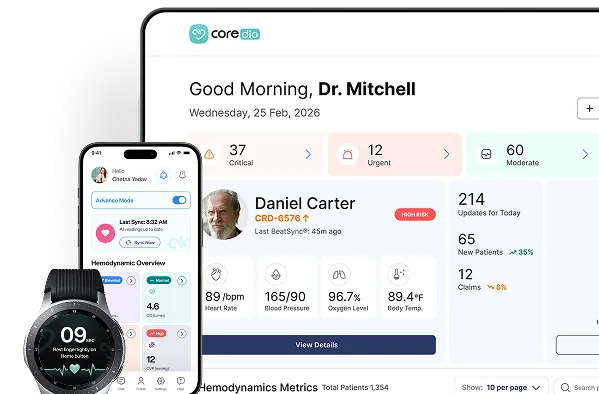
No. Coredio works with a consumer smartwatch you wear on your wrist no implants, no needles. Our AI and physics-based algorithms are designed to extract deep cardiac insights from your existing wearables, giving your care team a clearer picture of your heart health from home.
How does Coredio personalize my care?
Every heart is different. Coredio is designed to track your individual cardiac trends over time and surface them to your clinician so your treatment plan adapts to you, not a generic protocol. The goal: earlier, smarter interventions before a small change becomes a big problem.
What do I need to get started?
Upon Coredio officially launches, you will work with your care team to identify if your smartwatch is compatible, and you will receive a standard blood pressure cuff. That’s it. No specialized medical equipment, no complicated setup. If you don’t own a compatible watch yet, your care team can help you get one.
Who is Coredio built for?
Both sides of the care relationship. Cardiologists, primary care physicians, Nurses and rest of the care team use Coredio’s dashboard to remotely spot check heart failure patients and catch concerning trends early. Patients use a smartwatch and our app to stay connected to their care team from home. Caregivers and family members often help with initial setup and patient adherence.