1
Patient Onboarding
Patient enrollment with baseline health history, device assignment, and initial clinical assessment.
Patient consent and enrollment
Wearable device pairing
Initial health assessment
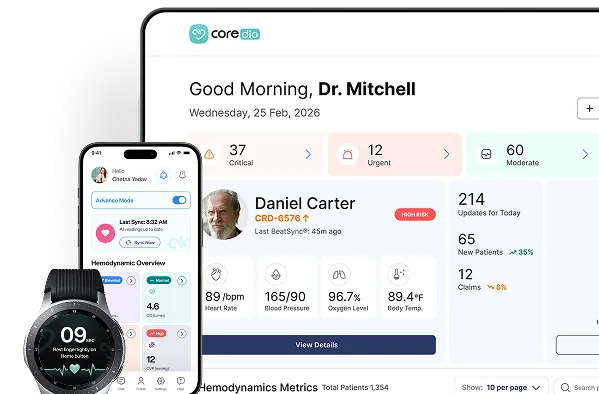
Personalized AI and sensor fusion provide early HF warnings and real-time heart data.

Patient enrollment with baseline health history, device assignment, and initial clinical assessment.
Patient consent and enrollment
Wearable device pairing
Initial health assessment
A 3-minute clinical session using PPG, ECG, ultrasound, and blood pressure to create a personalized digital twin.
Multi-signal capture
Ultrasound-informed measurements
Patient-specific baseline creation
Patients use their smartwatch and arm cuff at home or clinic for ongoing cardiovascular signal collection.
Wearable signal monitoring
Blood pressure measurements
Flexible home or clinic use
Advanced algorithms combine physics-based modeling with AI to estimate hemodynamic parameters from collected signals.
Signal processing
Physics-informed AI modeling
Hemodynamic parameter estimation
Care teams review trends, respond to alerts, and make informed decisions based on continuous cardiovascular insights.
Dashboard monitoring
Alert-based workflows
Trend analysis for intervention
Patient enrollment with baseline health history, device assignment, and initial clinical assessment.
Patient consent and enrollment
Wearable device pairing
Initial health assessment
A 3-minute clinical session using PPG, ECG, ultrasound, and blood pressure to create a personalized digital twin. The care team collects routine baseline measurements using existing non-invasive clinical tools to personalize the patient-specific model.
Multi-signal capture
Ultrasound-informed measurements
Patient-specific baseline creation
Patients use their smartwatch and arm cuff at home or clinic for ongoing cardiovascular signal collection.
Wearable signal monitoring
Blood pressure measurements
Flexible home or clinic use
Advanced algorithms combine physics-based modeling with AI to estimate hemodynamic parameters from collected signals.
Signal processing
Physics-informed AI modeling
Hemodynamic parameter estimation
Care teams review trends, respond to alerts, and make informed decisions based on continuous cardiovascular insights.
Dashboard monitoring
Alert-based workflows
Trend analysis for intervention
No. Coredio works with a consumer smartwatch you wear on your wrist — no implants, no needles. Our AI and physics-based algorithms are designed to extract deep cardiac insights from your existing wearables, giving your care team a clearer picture of your heart health from home.
Every heart is different. Coredio is designed to track your individual cardiac trends over time and surface them to your clinician — so your treatment plan adapts to you, not a generic protocol. The goal: earlier, smarter interventions before a small change becomes a big problem.
Upon Coredio officially launches, you will work with your care team to identify if your smartwatch is compatible, and you will receive a standard blood pressure cuff. That’s it. No specialized medical equipment, no complicated setup. If you don’t own a compatible watch yet, your care team can help you get one.
Both sides of the care relationship. Cardiologists, primary care physicians, Nurses and rest of the care team use Coredio’s dashboard to remotely spot-check heart failure patients and catch concerning trends early. Patients use a smartwatch and our app to stay connected to their care team from home. Caregivers and family members often help with initial setup and patient adherence.
Join the clinicians who are exploring the future of cardiovascular monitoring