

FDA
Breakthrough Device Designation

FDA Breakthrough
Device Designation

Combining personalized calibration, wearables, and AI for proactive heart failure care.
FDA BREAKTHROUGH DEVICE • TAP PILOT ACCEPTED

Coredio Receives FDA Breakthrough Device Designation for CPSE™ and Acceptance into the FDA TAP Program

A Software as a Medical Device platform built to bring hemodynamic assessment beyond the hospital, into the physician office and the home.

SANTA CLARA, Calif., May 28, 2026 — Coredio today announced that the U.S. Food and Drug Administration (FDA) has granted Breakthrough Device Designation to the Cardiac Performance Simulation Engine (CPSE™), and accepted the platform into the FDA’s Total Product Life Cycle Advisory Program (TAP). The designation places Coredio on an accelerated, priority path toward a 510(k) submission.

Closing the heart failure monitoring gap

Heart failure affects tens of millions of people worldwide and remains one of the leading causes of hospital admission and readmission. The most informative hemodynamic measurements available today typically require cardiac catheterization in a hospital, or an implantable monitor available only to a small subset of eligible patients. The result is a blind spot between visits, where deterioration can go undetected until a patient is in crisis.

Clinicians feel that gap directly. Patients with complex, dynamic heart failure “often don’t get enough attention in between outpatient visits,” says Dr. Ioannis Mastoris, a heart failure and transplant cardiologist at Massachusetts General Hospital, a residual risk that today’s tools leave largely unaddressed.

That is the gap CPSE was built to close. The hemodynamic signals that warn of decline “have lived inside the hospital, behind a catheter or an implant, for decades,” said Yashar Seyed Vahedein, PhD, Coredio’s co-founder and CEO, “but patients decline between visits, far from any of that.”

That framing resonates with cardiologists who manage these patients. Dr. Jagmeet P. Singh of Mass General Brigham notes that heart failure care “has long been limited by the gap between what we can measure in the hospital and what we can reliably understand once patients return home,” and says Coredio’s approach has the potential to give clinicians “a more holistic view of patient cardiac function and enable earlier intervention.”

How CPSE works

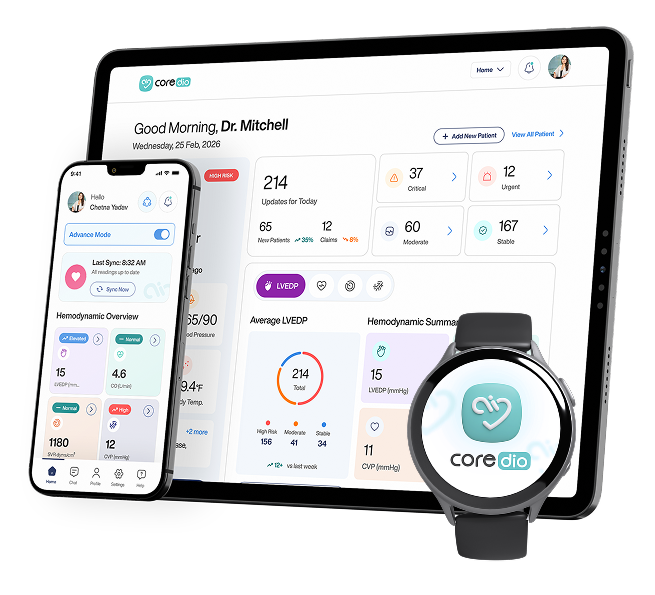
CPSE is a Software as a Medical Device (SaMD) platform that pairs a physics-based digital twin of the patient’s cardiovascular system with machine learning trained on clinical data, to identify abnormal hemodynamic status non-invasively. After an initial personalization step, patients use a consumer smartwatch and a standard blood pressure cuff to provide on-demand readings for clinician review.

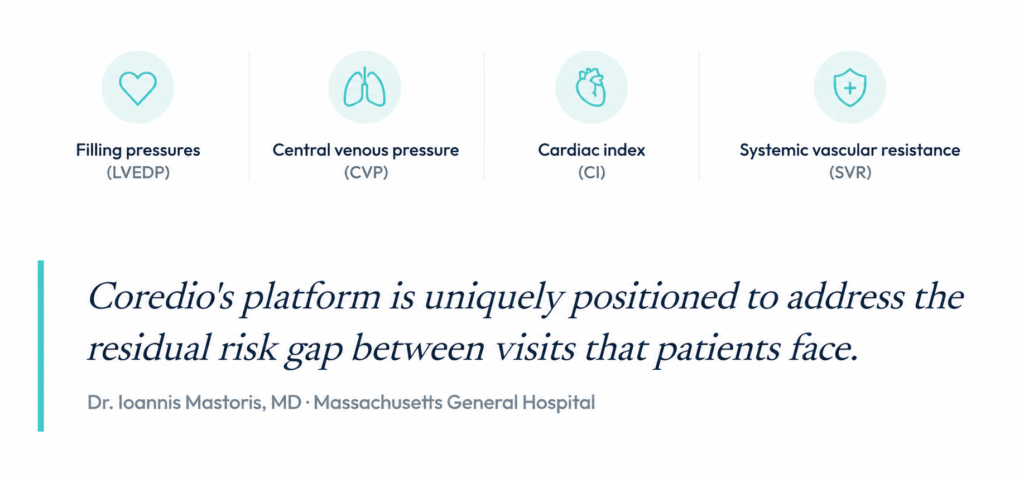
Mastoris describes the approach as using “a digital twin… to extrapolate catheterization-comparable hemodynamic data” from ordinary wearable devices, spanning the key parameters clinicians rely on to judge whether a patient is stable or decompensating:

Coredio's platform is uniquely positioned to address the residual risk gap between visits that patients face.

Dr. Ioannis Mastoris, MD • Massachusetts General Hospital

What the designation and TAP acceptance mean

THE FDA BREAKTHROUGH DEVICE PROGRAM

Intended to expedite the development and review of devices that may offer more effective diagnosis or treatment for life-threatening or irreversibly debilitating conditions, giving the sponsor priority interactive review with the agency.

THE TAP PILOT

Adds direct, ongoing strategic engagement with the FDA throughout development, with the shared goal of bringing safe and effective technologies to patients faster.

For Coredio, the recognition is both validation and runway. CPSE was built, in Vahedein’s words, to “bring those signals out of the hospital and into everyday care, non-invasively,” and he says the FDA’s Breakthrough Device Designation “puts us on a faster path to getting there.” Mastoris called the milestone an exciting development that “reflects the potential impact of this non-invasive monitoring approach.

What's next

Coredio is enrolling patients at IRB-approved clinical sites in support of its 510(k) submission. One of those sites is White Plains Hospital, where the technology is being studied in a longitudinal home-monitoring protocol for patients in the vulnerable weeks after discharge. Dr. Farrukh Jafri, who leads the study at White Plains Hospital, says what drew his program to Coredio was its potential to bring “hemodynamic-level data into that gap, without requiring invasive devices or additional clinical visits,” adding that the Breakthrough Device Designation “strengthens our confidence that this is a technology worth rigorously evaluating.”

The company is actively building partnerships with health systems and clinicians who share its goal of detecting hemodynamic deterioration earlier, where patients actually live.

IN THE NEWS

Additional coverage in Yahoo Finance and Cardiology News.

About Coredio

Coredio Corp. is a Santa Clara, California-based digital health company building the Cardiac Performance Simulation Engine (CPSE™), a Software as a Medical Device (SaMD) platform designed to bring catheterization-comparable hemodynamic assessment beyond the hospital, into the settings where it has not historically been available. Learn more at coredio-ai.com

CPSE™ is an investigational device and is not currently cleared or approved by the FDA for clinical use. The granting of a Breakthrough Device Designation does not constitute FDA clearance or approval, nor a guarantee that the device will be cleared or approved. Performance figures and clinical claims described herein are from ongoing investigational studies and should be interpreted accordingly.

FOR CARDIOLOGISTS  ·  CLINICAL EVIDENCE  ·  6 MIN READ

Coredio Receives FDA Breakthrough Device Designation for CPSE TM and Acceptance into the FDA TAP Program
May, 29 2026
Yashar

A Software as a Medical Device platform built to bring hemodynamic assessment beyond the hospital, into the physician office and the home

SANTA CLARA, Calif., May 28, 2026 — Coredio today announced that the U.S. Food and Drug Administration (FDA) has granted Breakthrough Device Designation to the Cardiac Performance Simulation Engine (CPSE™), and accepted the platform into the FDA’s Total Product Life Cycle Advisory Program (TAP). The designation places Coredio on an accelerated, priority path toward a 510(k) submission.

Closing the heart failure monitoring gap

Heart failure affects tens of millions of people worldwide and remains one of the leading causes of hospital admission and readmission. The most informative hemodynamic measurements available today typically require cardiac catheterization in a hospital, or an implantable monitor available only to a small subset of eligible patients. The result is a blind spot between visits, where deterioration can go undetected until a patient is in crisis.

Clinicians feel that gap directly. Patients with complex, dynamic heart failure “often don’t get enough attention in between outpatient visits,” says Dr. Ioannis Mastoris, a heart failure and transplant cardiologist at Massachusetts General Hospital, a residual risk that today’s tools leave largely unaddressed.

That is the gap CPSE was built to close. The hemodynamic signals that warn of decline “have lived inside the hospital, behind a catheter or an implant, for decades,” said Yashar Seyed Vahedein, PhD, Coredio’s co-founder and CEO, “but patients decline between visits, far from any of that.”

That framing resonates with cardiologists who manage these patients. Dr. Jagmeet P. Singh of Mass General Brigham notes that heart failure care “has long been limited by the gap between what we can measure in the hospital and what we can reliably understand once patients return home,” and says Coredio’s approach has the potential to give clinicians “a more holistic view of patient cardiac function and enable earlier intervention.”

How CPSE works

CPSE is a Software as a Medical Device (SaMD) platform that pairs a physics-based digital twin of the patient’s cardiovascular system with machine learning trained on clinical data, to identify abnormal hemodynamic status non-invasively. After an initial personalization step, patients use a consumer smartwatch and a standard blood pressure cuff to provide on-demand readings for clinician review.

Mastoris describes the approach as using “a digital twin… to extrapolate catheterization-comparable hemodynamic data” from ordinary wearable devices, spanning the key parameters clinicians rely on to judge whether a patient is stable or decompensating:

What the designation and TAP acceptance mean

For Coredio, the recognition is both validation and runway. CPSE was built, in Vahedein’s words, to “bring those signals out of the hospital and into everyday care, non-invasively,” and he says the FDA’s Breakthrough Device Designation “puts us on a faster path to getting there.” Mastoris called the milestone an exciting development that “reflects the potential impact of this non-invasive monitoring approach.”

What's Next

Coredio is enrolling patients at IRB-approved clinical sites in support of its 510(k) submission. One of those sites is White Plains Hospital, where the technology is being studied in a longitudinal home-monitoring protocol for patients in the vulnerable weeks after discharge. Dr. Farrukh Jafri, who leads the study at White Plains Hospital, says what drew his program to Coredio was its potential to bring “hemodynamic-level data into that gap, without requiring invasive devices or additional clinical visits,” adding that the Breakthrough Device Designation “strengthens our confidence that this is a technology worth rigorously evaluating.”

The company is actively building partnerships with health systems and clinicians who share its goal of detecting hemodynamic deterioration earlier, where patients actually live.

Categories :